Why Is a Guru Necessary for Self-Realisation?

In Short: Self-effort matters, and sincerity always pays. But a self-realised Guru changes what is possible for a seeker in ways that solitary practice cannot. This article looks at what that guidance actually does: how it reshapes karma, how it accelerates inner progress, and why complete surrender to a Guru remains the surest path to Self-realisation.

The Question Every Sincere Seeker Eventually Asks
At some point, most seekers wonder whether they really need a teacher at all. Books exist. Recorded talks exist. Apps promise guided paths to enlightenment on a schedule that fits around work and family. It is a reasonable question, and it deserves a direct answer.
Without a self-realised Guru, a seeker can still practise, still study, still sit in meditation with genuine sincerity. What becomes far harder, close to impossible, is attaining liberation itself. This is not a discouragement. It is simply what this tradition has found to be true across generations of seekers walking the same path.
A Teaching Echoed Across Centuries
This is not a claim invented for the modern seeker. Three of the oldest and most authoritative texts in this tradition say the same thing, each in their own words:
From the Vivekachudamani, attributed to Adi Shankaracharya:
Sanskrit: दुर्लभं त्रयमेवैतद्देवानुग्रहहेतुकम् । मनुष्यत्वं मुमुक्षुत्वं महापुरुषसंश्रयः ॥
Transliteration: durlabhaṃ trayamevaitad devānugrahahetukam, manuṣyatvaṃ mumukṣutvaṃ mahāpuruṣasaṃśrayaḥ
Translation: Three things are exceedingly rare, and come only by the grace of God: birth as a human being, a genuine longing for liberation, and the shelter of a realised soul.
In other words, a human life gives a seeker the opportunity. A sincere longing gives it direction. But it is the third blessing, the shelter of a realised soul, a living Guru, that carries a seeker the rest of the way. Shankaracharya does not list this as optional. He lists it alongside human birth itself as one of the three rarest gifts a soul can receive.
From the Bhagavad Gita, spoken by Krishna to Arjuna (4.34):
Sanskrit: तद्विद्धि प्रणिपातेन परिप्रश्नेन सेवया । उपदेक्ष्यन्ति ते ज्ञानं ज्ञानिनस्तत्त्वदर्शिनः ॥
Transliteration: tad viddhi praṇipātena paripraśnena sevayā, upadekṣyanti te jñānaṁ jñāninas tattva-darśinaḥ
Translation: Learn this by approaching a realised master with humility, by asking sincere questions, and by serving him. Those who have seen the Truth will impart that wisdom to you.
Krishna does not tell Arjuna to arrive at this wisdom through study or intellect alone. He names three specific actions- approaching a master, inquiring with sincerity, and serving him- as the way this wisdom is actually transmitted. The wisdom exists in the master because he has seen the Truth directly. It reaches the seeker only through that transmission.
From the Mundaka Upanishad (1.2.12):
Sanskrit: परीक्ष्य लोकान्कर्मचितान्ब्राह्मणो निर्वेदमायान्नास्त्यकृतः कृतेन । तद्विज्ञानार्थं स गुरुमेवाभिगच्छेत्समित्पाणिः श्रोत्रियं ब्रह्मनिष्ठम् ॥
Transliteration: parīkṣya lokān karmacitān brāhmaṇo nirvedamāyān nāsty akṛtaḥ kṛtena, tad vijñānārthaṁ sa gurum evābhigacchet samit-pāṇiḥ śrotriyaṁ brahma-niṣṭham
Translation: Having examined all that is gained through action and finding no lasting truth in it, a seeker should, in humility, approach a Guru who is deeply versed in the scriptures and firmly established in Brahman, in order to attain that wisdom.
The image here is deliberate. The seeker arrives with fuel in hand, ready to serve, not ready to debate. The text is explicit that this wisdom of the Eternal cannot be produced by anything that is not itself eternal. It has to be received from one who is already established in it.
Three different texts, three different eras, one consistent teaching: the wisdom that ends the search for truth does not arrive through self-effort alone. It is received from a Guru who has already walked the path to its end.
What Self-Effort Alone Can and Cannot Do
Sincere, genuine effort always pays dividends, and no teaching here suggests otherwise. A seeker who approaches practice with honesty and dedication will move toward truth. But self-effort operates within the limits of the seeker's own understanding, and those limits are exactly what a Guru exists to dissolve.
For someone walking without guidance, karma continues to shape and control the direction of life. For a yogi living under the guidance of a self-realised Guru, that changes. Karma and destiny stop having the same grip. Over time, a life once governed by past patterns begins to be rewritten, not by the seeker's own effort alone, but through the Guru's compassion.
What Changes When a Guru Enters the Picture
The meeting itself is rarely something a seeker can plan. Both Guru and disciple search, each in their own way, but who finds whom is the divine play of existence itself, shaped by the seeker's spiritual state and the karmic balance carried in from previous births.
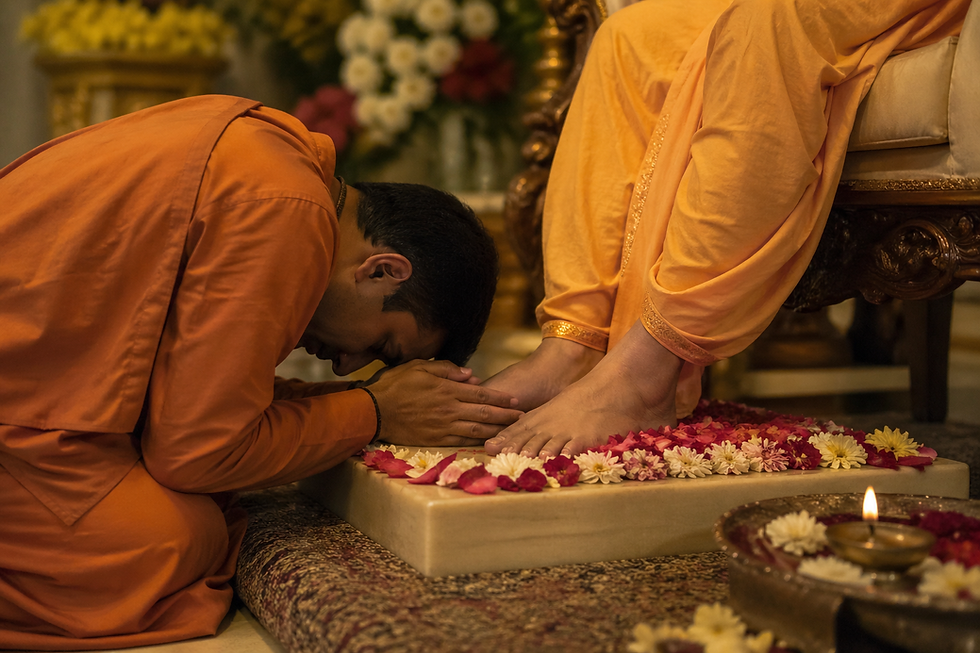
Once that meeting happens and a seeker surrenders the sense of separate "I" at the Guru's feet, the Guru begins to guide the disciple's life with deep compassion.
A disciple's spiritual life comes to reflect the Guru's own wisdom, the way the moon reflects light it does not generate on its own. This is not a relationship that reduces to technique or instruction. It works because a Guru acts as a mirror, reflecting a disciple's own thoughts and actions back with a clarity the disciple could not reach alone.
The Role of Surrender
None of this asks a seeker to switch off discernment. What it asks for is complete surrender: offering body, mind, and soul entirely to the Guru, not performing devotion as ritual or habit. Real surrender begins exactly where the ego ends. It is this offering, not intellectual conviction alone, that opens a seeker to receive what a Guru's grace makes possible.
Once that surrender is genuine, the seeking itself changes shape. A seeker's path no longer depends solely on personal willpower and study. It becomes a shared journey, carried forward by the Guru's guidance as much as by the seeker's own sincerity.
Why This Differs From a Self-Guided Approach
Self-guided spiritual practice can build discipline, calm the mind, and deepen understanding. What it cannot replicate is the living transmission that passes between a self-realised Guru and a sincere disciple, the initiation into the chakras, the correction only a teacher who has walked the path can offer, the compassion that reshapes karma from the outside rather than asking the seeker to untangle it alone.
This is why the search for truth does not end with the right book or the right technique. It ends when a seeker finds the realised Guru and surrenders enough to let the master lead.
Key Takeaway: Sincere self-effort is never wasted, but it has limits that a self-realised Guru exists to dissolve. Under a Guru's guidance, karma begins to shift, inner progress accelerates, and a seeker's life is reflected back with a clarity solitary practice rarely reaches. Complete surrender, not ritual, is what opens the door to that grace.
FAQs
Can a person reach self-realisation without a Guru?
Sincere self-effort always moves a seeker toward truth, but without a self-realised Guru's guidance, liberation becomes extremely difficult to attain. A Guru's guidance is what this tradition holds as necessary for that final step.
How does a seeker find the right Guru?
The meeting is a divine play of existence: both Guru and disciple search in their own way, and who finds whom is shaped by the seeker's spiritual state and karmic history rather than deliberate searching alone.
What does surrender to a Guru actually mean?
It means offering body, mind, and soul completely, not performing rituals or gestures on autopilot. Real surrender begins where the ego ends.
Does having a Guru change a person's karma?
Under a self-realised Guru's guidance, karma and destiny stop having the same hold they once did. Over time, a life once shaped by past patterns begins to be rewritten through the Guru's compassion.
Is self-study or reading enough on its own?
Books and self-study can inform and sharpen understanding, but they cannot replace the living guidance a self-realised Guru offers, which reaches a depth solitary study does not reach on its own.
For those ready to walk this path under proper guidance, structured meditation and initiation programmes are open to seekers at every stage. [Explore the Path →]


Comments