Sahasrara Chakra Explained: Meaning, Location and Benefits of Meditating on Crown Chakra

At the very crown of the head, where a newborn's skull is softest before it ever hardens, sits the seventh of the nine chakras: Sahasrara, also called Thuriya, the doorway to Moksha itself. This guide covers all of it: where Sahasrara sits, how it is initiated, what unfolds through sincere sadhana there, and why, without meditating here, true enlightenment cannot be reached at all.

What Is the Sahasrara Chakra?
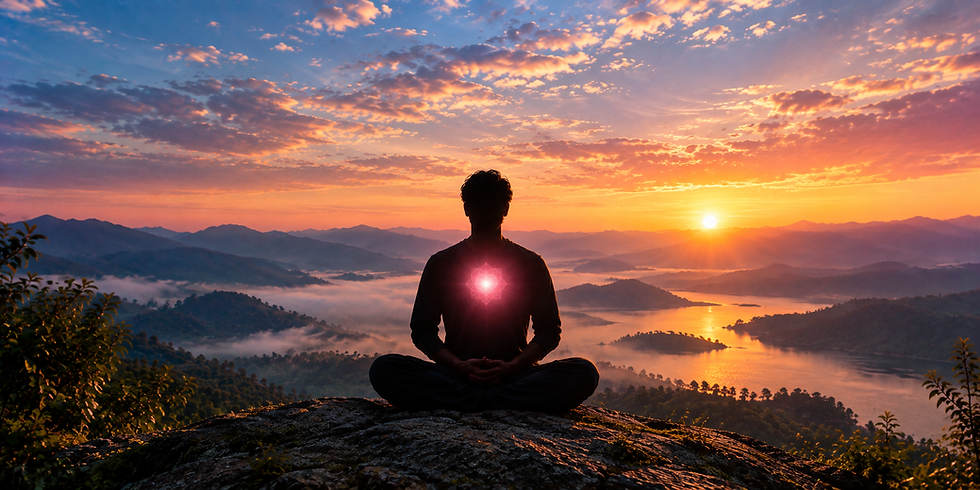
Sahasrara is the seventh of the nine chakras, seated exactly at the crown of the head. It carries several names: Thuriya, meaning to transcend everything and become one with existence, with cosmic consciousness itself; Brahmarandhra, an opening from the body directly into the Bramham, the divine supreme consciousness that pervades the universe; and Sahasrara, the thousand-petal lotus, named for the blooming a seeker feels while meditating here. Only in this chakra does a yogi's spiritual experience become complete, and without meditating here, true enlightenment cannot be reached at all.
What Is Kundalini and What Are Chakras?
Every seeker eventually arrives at the same two questions: What is this energy, and what are chakras? Kundalini is not something rare or reserved for the exceptional. It exists in every human being, though most people draw on only a small part of it, the rest spent on restless thinking and worry, which is why ordinary life can feel tiring for no clear reason. This energy lies dormant at the base of the spine until it is stirred.
Chakras are the points this energy passes through once it rises. They are the doors to the true self, to moksha, to enlightenment. Each of the nine carries its own character and its own gift for the seeker who meditates there, and together they are the only doors of inner travel available to a seeker.
Where Is the Sahasrara Chakra Located?
Sahasrara sits exactly at the crown of the head, the topmost of the nine chakras. In a newborn, this same point remains soft, the fontanelle known as the Brahmarandhra, and only hardens fully as the child grows. Inside the womb, this point stays open so the child receives energy through it from existence itself, a connection every human being carries from their very first moments of life, long before any seeker ever begins sadhana.
How Is the Sahasrara Chakra Initiated?
No one initiates Sahasrara through effort alone. Kundalini Shakti stays dormant in every human being until a realised master, or a disciple trained and entrusted by him, stirs it through touch or sight, carrying the dormant energy up the spine and settling it, most often, at the eyebrow centre first.
Sahasrara itself, sitting at the very top of the ascent, is reached only once a seeker's sadhana has carried this energy the whole way up, through every chakra beneath it. The climb from one chakra to the next is traditionally described as close to a year of sustained practice, which would place the crown far along a very long road. However, grace does not follow that clock. A seeker can be initiated directly into Sahasrara by a realised Guru or a disciple trained and entrusted by him, without waiting through the traditional sequence at all.
Which Deities Govern the Sahasrara Chakra?
Every chakra carries its own set of divine forces, and Sahasrara is no exception. The Athidevatha is the presiding deity, holding the core spiritual power of this centre, and the Prathidevatha supports that power, helping carry its transformation forward. A third, smaller force, the Upadevatha, attends alongside both.
Sahasrara also works as a portal in its own right, an antenna through which energy from outside the body, even cosmic rays, descends, connecting a seeker to existence, to other planes and, in time, to the divine consciousness these three forces represent.
What Are the Benefits That Unfold Through Sadhana in the Sahasrara Chakra?
As Kundalini energy is enkindled in a seeker and the Sahasrara chakra is initiated through a Guru's grace, bliss arrives, unlike anything ordinary life offers. This state is called anandam, a blissful state so complete that a yogi can feel as though the self itself is dissolving in that happiest moment, entirely unlike the fleeting happiness that comes from a desire being fulfilled. Bliss simply radiates from this chakra. In that fullness, every desire comes to feel needless, childish and superficial, since nothing further is left to want.
This same sadhana burns karma at its root. Past wrongdoing in this present life is released, and, drawing on Saint Thirumoolar's Thirumandiram, the grace of Lord Shiva, who resides at the crown of the head, opens the knots of past karma while holding what is still to come in check. The guilt that comes from old wrongdoing eases, and a seeker's passage towards moksha becomes far more direct.
The mind, too, is transformed. Meditating at Sahasrara activates portions of the brain otherwise left dormant, and a seeker with sustained awareness learns to locate the very origin point of a thought as it arises, after which it simply ceases, leaving the mind genuinely silent rather than merely quiet for a moment. A seeker comes to live increasingly free of attachment, rooted more in the cosmos than in the body, and what once felt like loneliness transforms into a blissful aloneness instead.
Sustained sadhana here also opens access to a wide range of siddhis: reading another person's aura, sensing the thoughts moving through someone else's mind, feeling subtle shifts in space, even revisiting past moments of this life to release what was carried unconsciously from them. None of this is ever the reason a seeker meditates here. These openings are not to be used, since they distract a seeker from the only goal that ever truly matters, and existence itself takes care to grant this kind of access only to a soul ready to carry it. Whatever opens through sadhana at Sahasrara arrives purely as a byproduct of sincere practice under grace, gated entirely by the Guru's discretion.
How Does the Sahasrara Chakra Serve a Seeker's Path to Self-Realisation?
Sahasrara is the point where desire finally loses its grip, and the oldest karmas of this life are burned away, leaving the mind genuinely silent for the first time. This silence matters more than it first appears: an enlightened master's words and way of living can never be understood through the reasoning mind, which is why a seeker is encouraged to meditate here, extensively, before ever attempting to interpret a Guru's teaching through the intellect alone. What opens at Sahasrara, profound stillness, complete bliss, and a connection to existence that reaches far beyond the body, is the doorway to Moksha itself.
Key Takeaway
Sahasrara sits at the very crown of the head, and only a Guru's grace can initiate it, never self-practice or a fixed timeline. Sincere sadhana here works on more than one level at once: it dissolves a seeker's desires into complete bliss, burns away the oldest karmas of this life, silences the mind at its very root, and opens siddhis that are never the goal and never something to chase. Without meditating here, true enlightenment cannot be reached at all. None of these arrives as separate rewards. They unfold together, carrying a seeker to Self-realisation and, ultimately, to Moksha itself.
For guidance on where to begin, seekers are welcome to reach out to understand the right starting point.
FAQs
What does Sahasrara mean? Sahasrara is the seventh of the nine primary chakras in the Kundalini system, also known as the crown chakra or Thuriya. It sits exactly at the crown of the head.
Where exactly is the Sahasrara chakra located? Exactly at the crown of the head, the topmost of the nine chakras. It is widely known as the crown chakra, Thuriya or Brahmarandhra.
Can the Sahasrara chakra be initiated through self-practice alone, without a Guru? No. Kundalini Shakti is stirred only by the touch or sight of a realised master, or of a disciple trained and entrusted by him, opening the channel connecting all nine chakras. Self-guided technique or willpower cannot initiate Sahasrara or any other chakra.
Does it really take a year to reach the Sahasrara chakra? Traditionally, the climb from one chakra to the next is described as close to a year of sustained practice, which would place the crown very far along the path indeed. Grace, however, is not bound to that timeline. A seeker can be initiated directly into Sahasrara by a realised Guru or a disciple trained and entrusted by him, without waiting through the traditional sequence.
Why is Sahasrara considered the destination of the entire chakra system? Because only in this chakra does a yogi's spiritual experience become complete, and without meditating here, true enlightenment cannot be reached at all.
What does it mean that a yogi may "feel as though the self is dissolving" at Sahasrara? The bliss opening at Sahasrara is so complete that it differs entirely from the ordinary happiness that comes from a desire being fulfilled. It is this totality of bliss, not anything to do with the body, that the phrase refers to.
Does meditating in the Sahasrara chakra clear karma? Yes. Sustained sadhana here burns away wrongdoing from this present life and eases the knots of past karma, easing a seeker's passage towards moksha.
Does the Sahasrara chakra bring siddhis or psychic abilities? Sustained sadhana here can open access to a range of siddhis, including reading another person's aura, sensing another person's thoughts, and sensing subtle shifts in space. These should never be used or pursued, since they distract a seeker from the only goal that ever truly matters, and any such opening remains entirely the Guru's decision.
What are the Athidevatha and Prathidevatha, and how do they relate to the Sahasrara chakra? Every chakra, including Sahasrara, carries a presiding deity called the Athidevatha and a supporting deity called the Prathidevatha, along with a lesser attendant, the Upadevatha. Together, these divine forces shape the transformation that unfolds as a seeker's energy comes to settle here.
What is the difference between Kundalini and a chakra? Kundalini is the dormant life energy itself, residing at the base of the spine in every human being. Chakras are the nine energy points, Sahasrara among them, through which this energy travels once it has been stirred.
What is the difference between Ajna chakra and Sahasrara chakra? Ajna sits between the eyebrows and is where a seeker's oldest desires and impurities begin to burn away. Sahasrara rises above it, at the very crown, and is where that burning completes, the doorway to the bliss and stillness of Moksha itself.
Is Sahasrara connected to a newborn baby's soft skull? Yes. The soft spot at the crown of a newborn's head, the brahmaranthra, corresponds to the Sahasrara chakra. It remains open in the womb so the child can receive energy through it from existence, and only hardens fully as the child grows.


Comments